
- 6 March 2027
- 24 April 2027
- 22 May 2027
- 26 June 2027
- 16 October 2027
- 27 November 2027
- 29 January 2028
- 26 February 2028
- 20 May 2028
- 24 June 2028
- 14 October 2028
- 25 November 2028
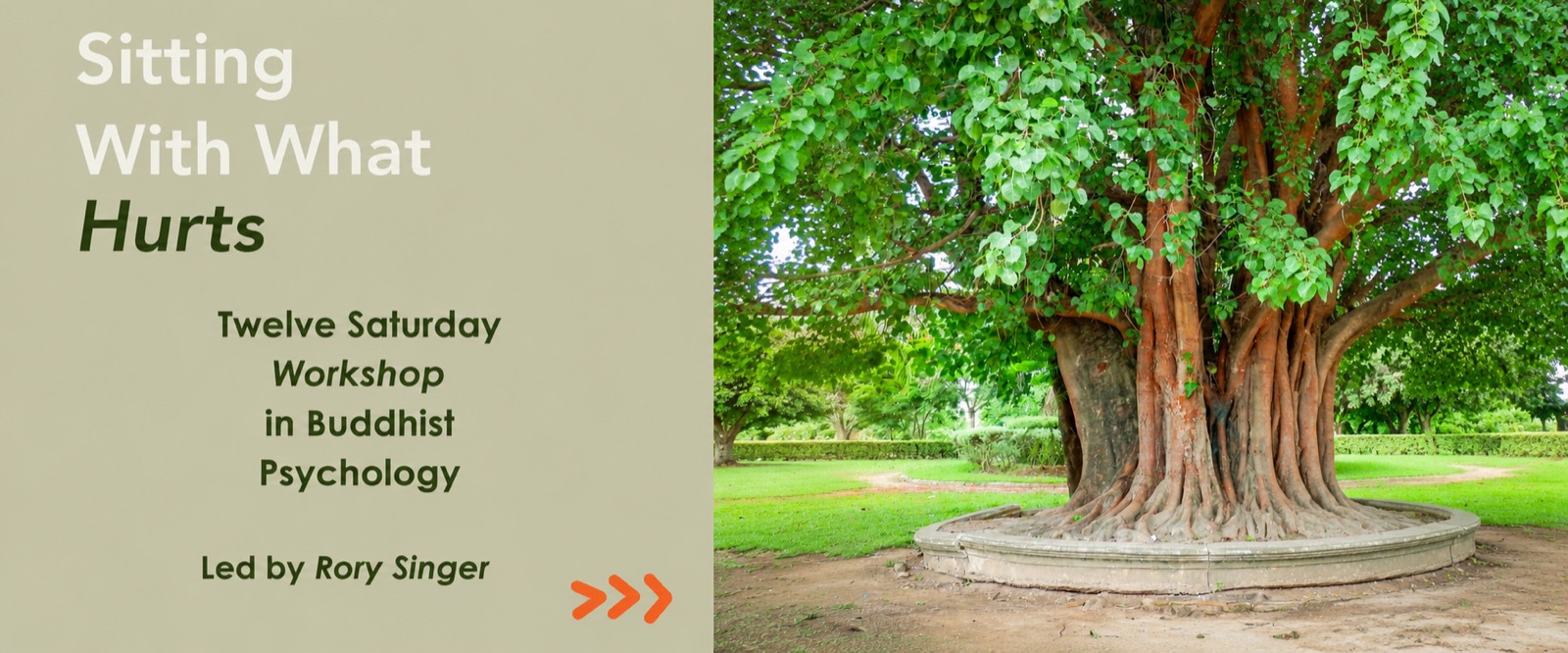
Twelve Saturdays in Buddhist psychology: theory and practice for clinical work. A two-year study and practice group facilitated by Rory Singer.
For counsellors, psychotherapists, clinical psychologists, psychiatrists and trainees.
When someone we care about is in pain, the urge to act arrives before we notice it. We reassure, explain, and offer a plan. Staying with what cannot be fixed is harder, and few of us were ever taught how. For anyone whose working life is spent with human distress, this is the heart of the work.
The Buddha’s teaching begins in the same place, with the plain fact that life hurts and that we add to that hurt in how we meet it. Much contemporary practice already draws on this teaching: mindfulness-based cognitive therapy, compassion-focused therapy, ACT and DBT all have their roots in it. This group goes back to the source, reading it in its own context and asking what it offers those of us who sit with distress every day.
Over twelve Saturdays, we follow the Buddha’s life from his birth to the night of his awakening, then explore the teachings he gave: the four noble truths and the eightfold path. We read the early Pāli suttas closely, meditate together, and discuss what the teachings ask of us, both in the consulting room and beyond.
Six Saturdays a year over two years, 10:00–17:00.
Venue: New Road Psychotherapy, 73 Church Road, Hove BN3 2BB. Each day runs from 10:00 to 17:00, with an hour’s break for lunch. Lunch is not included. Church Road has plenty of cafés and sandwich shops, and you are welcome to bring food; we have a kitchen and garden.
Full series: £110 per Saturday (£220 per term; £1,320 in total). New Road practitioners and trainees: £90 per Saturday (£180 per term; £1,080 in total). Series fees are payable by term, with two Saturdays per term.
Individual Saturdays, subject to availability: £125 per Saturday, or £105 for New Road practitioners and trainees. The opening term, on 6 March and 24 April 2027, is at the series rate for everyone.
The full course offers 72 hours of CPD. On completion, you receive a CPD certificate and a Certificate in Buddhist Psychology from New Road Psychotherapy. The Certificate in Buddhist Psychology requires attendance at ten of the twelve Saturdays; CPD certificates record the hours attended.
Alongside the suttas, the course draws on a contemporary account of the mind. Developed by Karl Friston, Andy Clark, Jakob Hohwy and Anil Seth, the predictive mind proposes that the brain does not wait to receive experience. It continually predicts experience and learns from the discrepancy between what it expects and what arrives. Lisa Feldman Barrett extends this account to emotion, Mark Solms links it to affect and drive, and Jeremy Holmes applies it to attachment and psychotherapy.
Much of the early Buddhist account of the mind reads naturally alongside it: how a feeling becomes a story, how craving seeks relief before we have chosen, how our views shape what we find, and how attention settles. Each Saturday includes a short reading on the predictive mind, placed where it fits the text best, to provide a platform for reflection on clinical practice.
The Buddha’s teaching leads, and the theory illuminates it without replacing it, even when the theory reaches its limits. Each day closes with practical ways to bring what we have explored into our work: how we listen, what we notice in ourselves, and how we stay with a client when nothing can be fixed.
Each session returns to questions every clinician knows, regardless of modality or stage of training: the pull to rescue, the need to stay with what cannot be fixed, the limits of effort, how a feeling becomes a story, and what we bring into the room and what the room brings out in us.
You will leave with a working understanding of how Buddhist psychology and the predictive mind each account for suffering and its alleviation, along with practices you can use in the room.
The deeper aim is not another technique for your repertoire. It is a steadier way of being with distress, your own and others’, and a group of colleagues with whom to explore it over two years.
Each Saturday runs from 10:00 to 17:00, with an hour for lunch, and is divided into two sessions. Each session opens with a meditation and a reading from the suttas, and one session each day also includes a short reading on the predictive mind.
Reflection then begins in groups of three, before the whole group comes together to draw out the threads. A handout is sent beforehand, with the reflective questions printed at the end: some for the room and some to carry into the weeks between Saturdays.
You are encouraged to keep a private notebook, which is never collected. The first Saturday begins with introductions and the agreements that will hold the group together.
Nothing in the group requires you to share client material. No prior knowledge of Buddhism or meditation is assumed, and Pāli terms are explained as they arise.
The course is designed to be taken as a whole. At its heart is a series of groups of up to twelve who commit to the two years together, allowing trust to build and conversations to go further than a one-off workshop can.
It begins with an opening term. Everyone joins for the first two Saturdays, on 6 March and 24 April 2027, at the series rate. This gives you time to meet the group, the material and the way we work before deciding on the rest.
By 24 April 2027, four weeks before the third Saturday, you can commit to the remaining ten Saturdays at the series rate and join the series group. If space is available, you can instead book individual Saturdays at the individual rate.
Series participants commit to all twelve Saturdays. If you miss a Saturday, you will still receive the handout and a brief catch-up with Rory. The Certificate in Buddhist Psychology requires attendance at ten of the twelve Saturdays; CPD certificates record the hours attended.
If your circumstances change, you may leave at the end of any term (each term comprises two Saturdays) by giving four weeks’ notice, with no further fees due. Fees already paid for the current term are not refundable. Any vacancy in the series group is offered only at the start of the second year to maintain group stability.
When the series group has fewer than twelve, the remaining places are open to anyone wishing to attend individual Saturdays. Booking both Saturdays in a term is encouraged to maintain continuity.
The final Saturday is reserved for the series group, which closes the series. All attendees agree to the group agreements and receive the handout in advance. Individual bookings receive a CPD certificate for the hours attended, and anyone who has attended individual Saturdays in the first year is welcome to join the series at the start of the second year.
Trainees are warmly welcome and offered the same reduced rate as NRP practitioners.
Rory Singer is Clinical Director of New Road Psychotherapy and co-founder of CPD Sussex. He works at the intersection of early Buddhist psychology, psychoanalytic and neuropsychoanalytic theory, and clinical practice. He practised as a psychotherapist for more than thirty-five years and has been a contemplative practitioner for forty-five years.
The series draws on his writing, The Four Noble Truths: Humiliation, Craving, Cessation and Path, and on his essays on Buddhist psychology and psychotherapy, published on Substack.
The title traces humiliation to its root in humus, the earth: to be humiliated, in this reading, is to be returned to the ground, where humility also begins.
1. 6 March 2027. Beginnings; The Palace and the Four Sights. Every client arrives with a birth and a beginning they did not choose, and so do we. The walled garden could not keep out the sights of ageing, sickness and death. The day asks what we protect ourselves from seeing, and what happens in the room when something gets past the wall.
2. 24 April 2027. Leaving the Palace; His Teachers. Leaving is part of every therapy and every training. The Buddha left two teachers, whose limits he found only by reaching them. The day looks at leaving as the fruit of going all the way, not as failure, and at what it asks of us when a client or a method reaches its limit.
3. 22 May 2027. The Ascetics and the Food; The Awakening. Therapists know the limits of effort, both in themselves and in clients who try harder and harder. The day follows the Buddha to the limit of effort and the night beneath the tree, and asks what becomes possible at that edge, and what it means to be given something we did not believe we had earned.
4. 26 June 2027. The Silence and the First Truth; The First Arrow. After his awakening, the Buddha hesitated over whether he could speak of what he had seen at all, a hesitation many therapists recognise. The afternoon turns to the First Noble Truth, which separates the pain itself from what we add to it. This distinction is as useful at home as in the room, and predictive accounts of pain now help explain it.
5. 16 October 2027. The Mustard Seed; The Loop Beneath the Feeling. Why do we and our clients hurry past what hurts? The day examines the urge to fix, console or explain, and the pattern beneath craving that keeps it going, read alongside Lisa Feldman Barrett’s account of affect, the feeling that arrives before the story.
6. 27 November 2027. The Honey-Ball; The Search and the Comparing Mind. A feeling becomes a story very quickly, and predictive theory explains why. The day explores the gap between the two, the search for love that underlies so much of what brings people to therapy, and the comparing mind, which therapists are not exempt from.
A note on “attuned”. The second year turns to the eightfold path, whose factors are each prefixed with the Pāli sammā, usually translated as “right”. This course uses “attuned” instead: in tune with what is here, rather than with what is perceived as correct.
7. 29 January 2028. The Fire Sermon; The Cooling and the Unborn. What does it mean for a pattern to cool? Most people in distress do not want to feel nothing; they want the fire to go out. The day explores ending, release and recovery, distinct from numbness or suppression, and holds the range of views offered by the traditions.
8. 26 February 2028. In Cessation Lies Happiness; The Whole of the Holy Life. Most happiness depends on how things turn out. The happiness described here does not, which makes it something we can hold out to someone who is suffering, even when their circumstances cannot change. The second session turns to good friendship, which the Buddha called the whole of the holy life, in both practice and the therapeutic relationship, and asks what a group like this one can become.
9. 20 May 2028. Attuned View; Attuned Intention. Two clinicians can hear the same story and see quite different difficulties, and how we see a difficulty shapes what we do about it. The day explores view and intention as ways we orient ourselves, in our own lives and in the work: what we are leaning towards and why.
10. 24 June 2028. Attuned Speech; Attuned Action. Therapy happens largely through speech, and every clinician has said something true at the wrong moment. The day asks what makes speech true, kind and timely, and brings the same questions to action, drawing on the Buddha’s advice to his young son to reflect before, during and after we act.
11. 14 October 2028. Attuned Livelihood; Attuned Effort. The helping professions are livelihoods too, with their own questions about power, money and need. The afternoon turns to effort, neither too tight nor too loose, a balance anyone at risk of burnout must find.
12. 25 November 2028. Attuned Mindfulness; Attuned Concentration. The last two factors bring the series back to practice: how attention is held, how it settles, and what predictive accounts of attention suggest meditation achieves. The day closes by returning to where the first teaching ends and to what each participant takes away.
Contact Rory at rory@newroadpsychotherapy.com or 07739 556438.